Terminal Moraine

It occurs to me that all you really need to know about my writing is that it is driven by the acute realization that all of Cape Cod and the Islands will be gone much sooner than I would like.

I feel like I am trying to document the last days of a civilization that will be one day wiped completely off the map.

Writing Sprints

IMG_5668


Every Sunday since early January, I have met with a friend at my favorite coffee shop. (On Nantucket, we lack in many things, but coffee is not one of them. I try to split my time and my money between a few.)

We talk a bit about the week, and then write until we can’t anymore, or until the coffee shop girls start turning down the lights and start scrubbing the floor with disinfectant. The smell of bleach is not as inviting as the smell of coffee beans. We take the hint.

This has been a good practice, because as much as I try to write every day, there are always a couple of days where something comes up, or I have to put a paid writing job at the top of my priority list instead of working on my (second? third? fourth? how do you count? do you only count the good ones? if we are only counting the good ones, it’s the second) novel. Then there are the short stories, poems, essays…

…and this blog.

Writing with someone, even just sitting across the table, in silence, with only the sound of fingers flying across the keys, feels different than writing alone.

Sometimes, when I am particular stuck and trying to unravel a long thread, or find the right words, or just words in general, I think about running. In particular, how running was something I never thought I could do. It took time and practice, and is still difficult. But in the years since I started, I’ve run farther than I’ve ever dreamed I could.

Then, when I am running (usually about…uh…right away) I have to remind myself of all the words I have written. Remember when you couldn’t write a story longer than 6,000 words? You’ve written things 10 times that! Get it in gear!

I keep exercising–running, indoor cycling, whatever–because it helps my unravel my writing thoughts. It reminds me that  I can do more now than I could in the past.

The thing about writing and running is, it’s easier to keep going if there’s someone to help you set the pace.


Pretend You are Talking to a Friend


IMG_5752 (3)

I have written before that in Provincetown in February, the dead outnumber the living. On a frigid, so-clear-you-can-see-to-Plymouth day, it seems especially true.

Yesterday, I drove down from Hyannis to Provincetown for the funeral, or celebration of life, of a well-known town character. It was cold–just hovering around 20 degrees–and the town was empty. Most sane people were home, where it was warm.

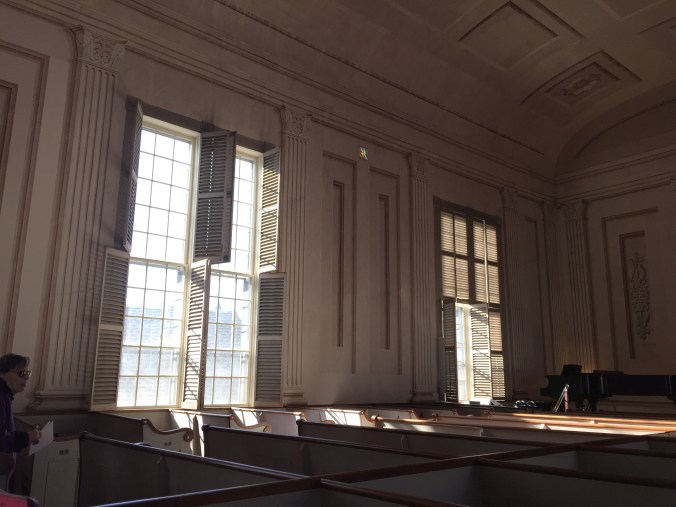
The service was in the Unitarian Universalist church, an old 1840s era building with two chapels and trompe l’oeil  frescoes adorning the walls. The same artist painted the UU church on Nantucket.

In the 1840s, the two towns must have shared more similarities than they do now. Nantucket in the 1840s was a world center. Somewhere along the way (I’d say 1916), Provincetown became the more cosmopolitan of the two. It’s hard to know if those kind of distinctions hold any meaning in the hyper-connected world we are in today. Sure, “the world comes to Nantucket,” but I don’t need to wait for the world to come to me anymore. (However, still I wait.)

The celebration was particularly moving because it was for someone had lived their life exactly the way they had wanted to. This meant no “traditional” family structure. There was no wife, no husband, no children. No brothers or sisters–a cousin and a college roommate were the ones who’d known him the longest.

But there were friends. Drinking buddies, coworkers, hangers-on. Pals, sympaticos, confidantes. There were friends whose relationships blurred over the years–from more than friends to friends and back again.

There was a woman in a fabulous fur coat in the spartan chapel. (The former Hicksite Quakers who became some of the first Universalists were rolling in their unmarked graves.)

He was not alone at the end, the confidante tells us. I think the entire church sighed in relief.

(Pretend you are talking to a friend.)


Hell or High Water; or, Winter on Nantucket

IMG_5259

Steps Beach in winter, Jan 4, 2018


I fought it for as long as I could, but sometime around the middle of December I caved in and realized it was indeed winter. I still travel with my bathing suit stashed in the car, but now the ice scraper and snow shovel are taking up residence, too.

The last couple days have been pretty brutal–extremely frigid temperatures, high winds, rain, and relative warmth, then back to freezing. This all took a toll on our aging sewer system, and for the last 48 hours it’s been discharging into the harbor. Over a million gallons.

Nantucket prides itself on our historic downtown, but we do not want to relive the smells of the past.

IMG_5223

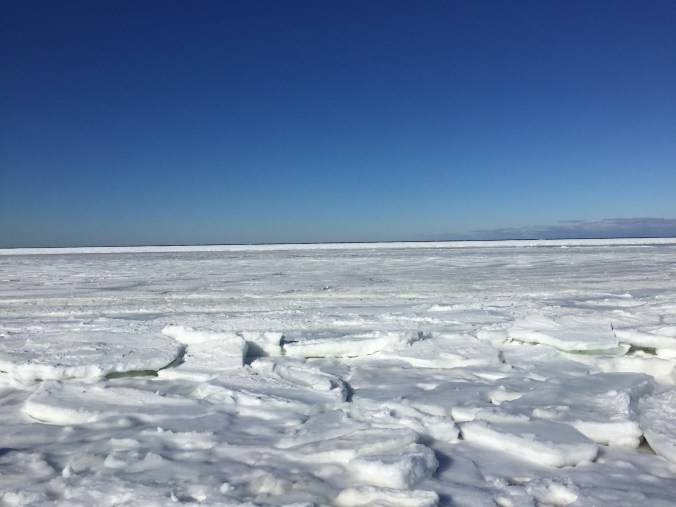
Frozen harbor west of the jetty, Jan 1, 2018

Today, it took a steamship upwards of three hours from Hyannis to travel behind the Coast Guard ice cutter. It brought over food, islanders stuck on the other side, and huge lengths of pipe. I know the town is working is hard as it can to clean up the streets and the harbor, but the weather is working against them. Monday promises a relative reprieve, a balmy 40 degrees.

By summer, this will all be a memory. Just another tale from the front lines of life in winter, traded for supper at fancy cocktail parties.

But the old timers are quick to remind me that there are still places on Nantucket that reek of whale oil, when the temperature is high and the wind is still.


The Fowler Shack, pt 1

IMG_4275


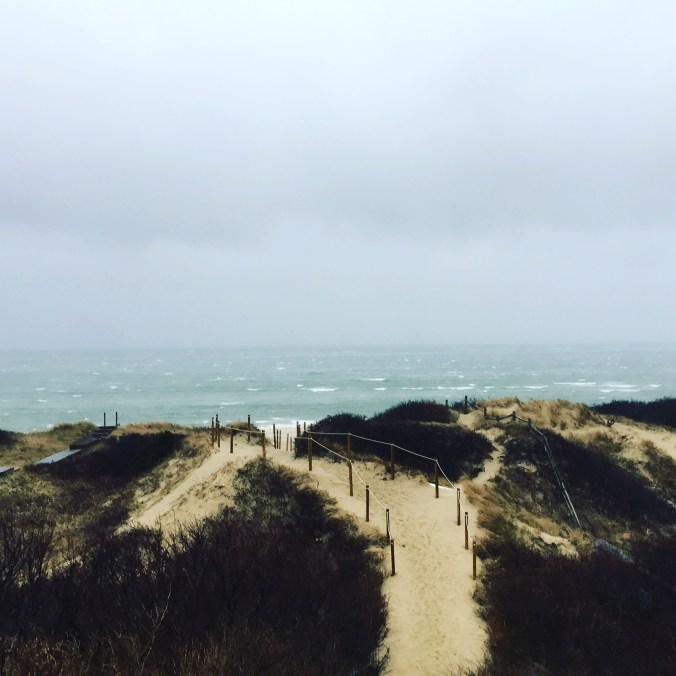
It is strange, or perhaps not, that for all I have written about the dunes, about Provincetown, in the last five years, but the last two years especially, how nearly paralyzed I am by the thought of writing about my experience there in October.

I’ve written two short essays that are out in the world, awaiting their fate in the digital slush pile. Those came to me quickly, and I started writing both while I was out there. But to make sense of the whole week will take more time.

I will say that it was harder than I thought, mentally and emotionally. In my real life, I wake up and go to the gym or run, I write for two hours, I go to work where I see only one or two other people, when the weather is good I go to the beach, when it isn’t I come home and write more.

It’s an island–there aren’t that many people to talk to.

But, if you read my recent piece on The Common, you’ll see that I live pretty close to other people. I might not always talk to them or hang out with them, but they are there. I see their lights come on in the morning, I hear their cars crunch over the shell driveway at night. In the summer, their kids ride their bikes and play hide-and-seek in the decorative tall grass that runs between my yard and the street.

It’s nice to know they are there.

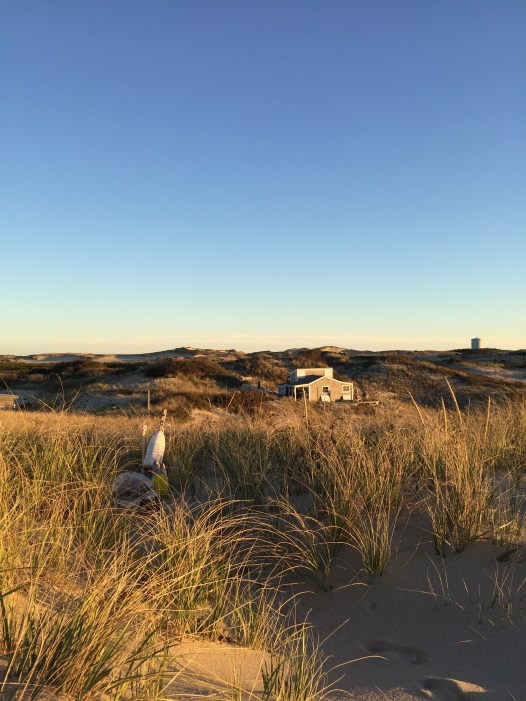
When the fellow from the Compact dropped me off out at the Fowler Shack (during the most brilliantly warm stretch of October weather–the hottest October on record, Christ), there were people in the two other shacks nearby, cleaning and readying their homes for fall.

Good, I thought. It won’t just be me and the coyotes.

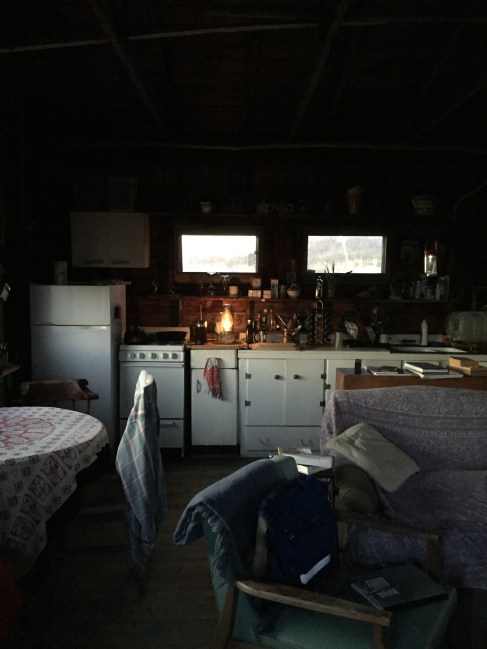
Hours later, I heard the sound of an engine turning over, and in a blink the car and the people were gone. The sun was, too. There I was, alone in the dark, not yet having figured out that I should light the hurricane lamps an hour before the sun starts to sink, not yet knowing how to start a fire.
IMG_4093

That first night, the darkness and the solitude hit me hard. The closest person in any direction was over a mile away, over the sand. I am used to being by myself, but I quickly learned that is very different from being completely alone.

I started thinking of Pat and Mary Anne and Sydney and Susan and the woman without a name, the Lady of the Dunes.

Me and the coyotes and the ghosts.

In the morning, the sun rose and the light seemed to stretch on forever.
IMG_3893

You been reading joke books again?

I like cracking jokes, making people laugh. I have this old coworker who used to say to me “What, did somebody tell you you were funny today?” if I started to get a little too heavy into the puns.

But to that, I say, YES.

Here’s a piece I wrote on McSweeney’s: https://www.mcsweeneys.net/articles/nantucket-summer-house-names-that-double-as-epitaphs. 

Yeah, THAT McSweeney’s!

I’ve been doing a lot of nature and place based writing lately, and now branching out into place-based humor, I guess!

IMG_8177

Art & Illness of Robert Lowell

“…The winds’ wings beat upon the stones,

Cousin, and scream for you and the claws rush

At the sea’s throat and wring it in the slush

Of this old Quaker graveyard where the bones

Cry out in the long night for the hurt beast

Bobbing by Ahab’s whaleboats in the East.”

-Robert Lowell, The Quaker Graveyard in Nantucket

Is there a link between mania and artistic creativity? In Robert Lowell: Setting the River on Fire, professor of psychiatry at the Johns Hopkins School of Medicine Kay Redfield Jamison seeks to explore this connection while uncovering a fuller picture of the great poet.

There is much to say about Lowell’s life, his struggle with manic depressive disorder, and how it affected his art and his interpersonal relationships. Jamison’s biography is not a traditional look at the arc of her subject’s life, but rather a deep dive into his medical history, his writing, and his relationships in an attempt to understand how a man could not only survive, but thrive an as artist, in in the midst of madness.

– See more at: https://nantucketbookfestival.org/news/the-art-and-illness-of-robert-lowell#sthash.XBfMZ4hC.dpuf

Kevin Young at the Nantucket Book Festival

Take a trip over to the Nantucket Book Festival site to read a piece I wrote about poet, archivist, historian, and general amazing human Kevin Young’s newest work Blue Laws.

“Reading through Kevin Young’s Blue Laws: Selected & Uncollected Poems, 1995 to 2015, I found myself remembering my days as a music nerd–obsessively on the hunt for a rare bootleg released only in Japan or some soundboard recording of a band’s final concert. Blue Laws feels like an equally rare artifact, both a collection of greatest hits and B-sides, and a great exploration into the poet’s back catalog.”

….you can read more here: http://nantucketbookfestival.org/news/kevin-young